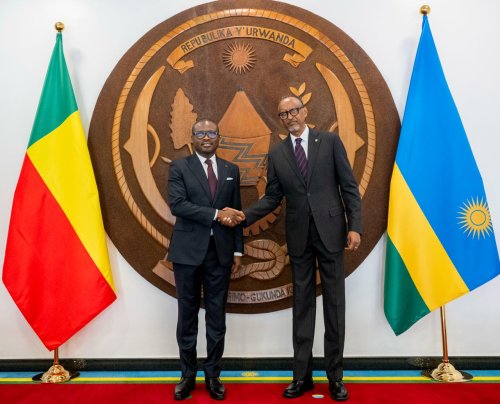
Rwanda, Russia Sign Agreement on Nuclear Energy Development.
Rwanda and Russia have signed an agreement to advance the country’s plans to develop nuclear energy as a source of clean and reliable power for its development needs.

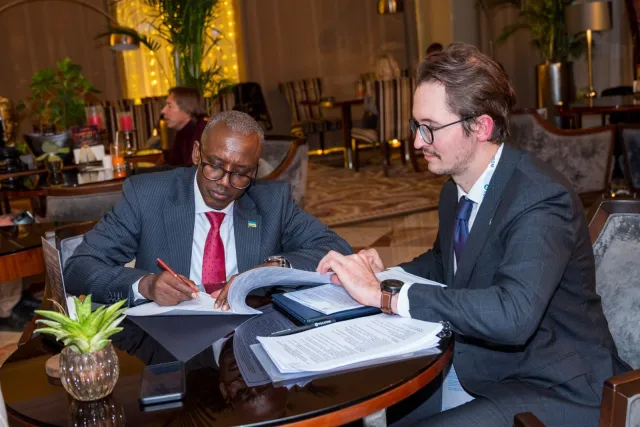
The agreement was signed between the Rwanda Atomic Energy Board (RAEB) and Russia’s state-owned nuclear energy corporation, Rosatom, during the Russia-Africa Summit, which has been taking place in Russia
Rwanda’s Ambassador to Russia, Maj Gen Joseph Nzabamwita, signed the agreement on behalf of the country. It provides for the development of a Small Modular Reactor (SMR) power plant and a Centre for Nuclear Science and Technology.
Nzabamwita said construction of the facilities is expected to begin soon in Rwanda. He added that the project will create employment opportunities for young people and support the training of nuclear scientists and technicians.
“Clean nuclear energy, the establishment of a Centre for Nuclear Science and Technology, and the training of nuclear scientists and technicians continue to be among the key pillars of cooperation between Rwanda and Russia,” he said.
He noted that nuclear energy and related technologies could bring practical benefits to Rwandans in several sectors, including healthcare, agriculture, mining and electricity generation.
In healthcare, the technology can be used in cancer treatment, while in agriculture it can help preserve produce. It can also support research into the location and processing of mineral resources, as well as the development of technical skills.
Nzabamwita said the technology would contribute to Rwanda’s development ambitions, particularly under the second National Strategy for Transformation (NST2) and Vision 2050.
“This technology is important for Rwanda’s development under the second National Strategy for Transformation and Vision 2050. Construction work will begin soon in Rwanda, and this will also help create jobs for our young people,” he said.
Rwanda has been advancing plans to introduce nuclear energy through Small Modular Reactors (SMRs), which are smaller than conventional nuclear power plants and can be developed in modules.
Unlike large nuclear power stations, which can have generating capacities of about 1,000 megawatts, SMRs allow countries to add generating capacity according to their electricity needs.
The reactors Rwanda is considering are expected to have a capacity of up to 200 megawatts each. By installing several units, the country could gradually increase electricity production as demand grows.
For example, instead of building one large facility capable of generating 1,000 megawatts, Rwanda could install reactors of different capacities depending on the amount of additional electricity required.
The approach would allow the country to expand its nuclear power generation in stages while developing the expertise and infrastructure needed to support the technology.