From Malnutrition to Hope: COPORWA's Nutrition Initiative Transforms Families in Rweru Sector
Bugesera District, Rwanda – In Rweru Sector, Bugesera District, a one-year project aimed at improving nutrition and food security among historically marginalized communities is changing lives and restoring hope.


Implemented by the Community of Potters of Rwanda (COPORWA) with support from UNDP through the GEF Small Grants Programme (SGP) and local government authorities, the project, titled “Improving Nutrition and Food Security among Children Under Five, Women of Reproductive Age, Including Pregnant and Breastfeeding Mothers among the Historically Marginalized People of Rweru Sector in Bugesera District,” began in June 2025 with a budget of USD 25,000.
The initiative targeted malnutrition among children under five, pregnant and breastfeeding mothers, while also strengthening household livelihoods and social cohesion.
A Community Once Affected by Malnutrition
For many residents, balanced diets and vegetable consumption were once unfamiliar concepts.

Musabyimana Odette, a resident of Ruzo Village in Nkanga Cell, recalls the situation before the project.
“Before COPORWA brought this project, we had no knowledge about balanced diets. We never imagined that vegetables such as carrots, beetroot, cabbage and others could be part of our daily meals. We only saw them in markets and thought they were for other people. Many of our children showed signs of malnutrition, and the health of pregnant and breastfeeding women was not good.”
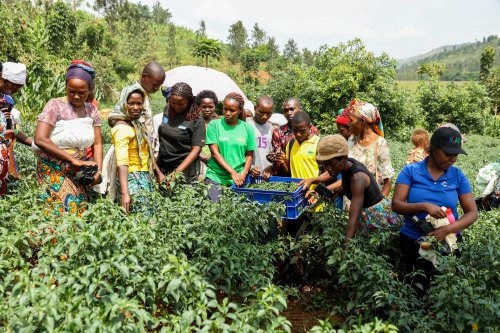
To address these challenges, the project established kitchen gardens, trained households on nutrition, promoted mushroom cultivation, organized savings groups, and distributed livestock.A total of 28 families received two goats each, helping improve household income and nutrition.
Restoring Dignity and Hope
Beyond improving nutrition, the project has also transformed social relations within families and the wider community.
Karasira Jean Bosco, one of the beneficiaries, says life was difficult before the intervention.

“Before this project arrived, we were struggling. Relationships within families were not good, and conflicts and violence were common.”
Community leaders have witnessed a remarkable transformation.
The village leader explains:
“When I was entrusted to lead this village, I was told that managing these residents would be difficult because conflicts, theft and alcoholism were widespread. But after the COPORWA project arrived, people became more aware, started working, and each household began finding ways to support itself through its own efforts.”
The project encouraged residents to make use of the small resources available to them. Through practical training, families learned how to establish kitchen gardens and cultivate mushrooms for both consumption and income generation.
Hategekimana Janviere, another beneficiary, says the results are visible.

“We learned how to grow vegetables and cultivate mushrooms. Today, you can simply harvest vegetables and mushrooms from your garden, wash them and cook them for your family. Our children are eating better than before, and sometimes we sell the surplus after setting aside enough food for the household.”
For Karasira Jean Bosco, the project changed mindsets.
“When the project started, they taught us how to avoid family conflicts and how to improve our livelihoods. We used to think that because we were poor, there was nothing we could achieve. They showed us how to make productive use of the little land we have and taught us how to establish kitchen gardens.”
The village leader notes that the community has earned a level of trust that once seemed impossible.
“In the past, people could not even entrust their goats to these households because there was a perception that youth would steal them within days. Today, families are raising livestock, maintaining kitchen gardens, and their living conditions have improved significantly.”
According to Providence, the Project Manager, the intervention was designed to address the most vulnerable groups.

“This project was developed to respond to the high levels of malnutrition that were particularly affecting women of reproductive age, pregnant and breastfeeding mothers, and children under five years old.”
The project also emphasized education, encouraging parents to keep children in school while strengthening community savings groups and financial resilience.
One of the notable achievements is the return of more than 10 children who had dropped out of school.
According to Ingabire Alexis, Executive Secretary of COPORWA:

“One of the lessons we learned from this project is that everything is possible. People often said these communities could not achieve much, but we proved that when you walk alongside people and support them, they can succeed. This contributes to the Government’s graduation agenda of helping households move out of poverty.”
Reflecting on the implementation journey, Providence says the project's success was largely driven by community participation and strong local leadership.
“Working with this community taught us that lasting change starts with trust. The support of grassroots leaders helped us mobilize residents, change mindsets, and encourage collective action. Their leadership was instrumental in turning a vulnerable community into one that is increasingly self-reliant and confident about its future.”
As the project concludes, beneficiaries express confidence that the achievements will continue.
Musabyimana Odette believes the knowledge gained is the project’s greatest legacy.
“What this project has helped us achieve will not disappear. The skills we have acquired in kitchen gardening and mushroom production will continue helping us earn a living even after the project ends. We will no longer lack health insurance, and no child will suffer from stunting because of poor nutrition.”

COPORWA also remains optimistic about the sustainability of the intervention.
“We are more than 90 percent confident that the beneficiaries will preserve these achievements,” says Ingabire Alexis. “The first thing we focused on was changing mindsets and providing knowledge. That foundation gives us confidence that the progress will continue long after the project has ended.”
What began as a nutrition-focused intervention has evolved into a broader story of empowerment, social cohesion, education, and economic resilience. Through livestock distribution, kitchen gardens, mushroom cultivation, nutrition education, and community mobilization, families in Rweru Sector are demonstrating that lasting change is possible when knowledge, opportunity, and local ownership come together.
Today, where malnutrition, conflict, and hopelessness once prevailed, households are producing food, generating income, keeping children in school, and building a healthier future for the next generation.