Francophonie Summit Postpones Leadership Election for One Year.
The International Organisation of La Francophonie (OIF) has postponed the election of its next Secretary-General by one year after member states failed to reach consensus during the 20th Francophonie Summit in Phnom Penh, Cambodia, on November 16, 2026.

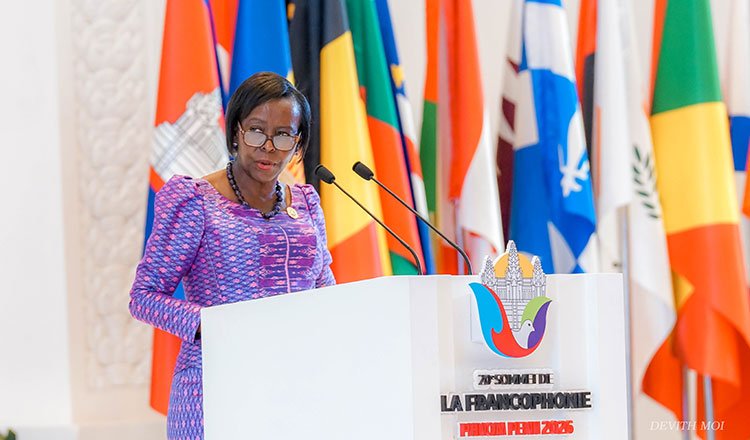
The decision means Rwanda’s Louise Mushikiwabo, who was seeking a third term, will remain at the helm of the organisation for another year, while Rwanda will not field a candidate in the next election, according to sources close to the negotiations cited by Agence France-Presse (AFP).
The leadership contest had become a major source of tension between Rwanda and the Democratic Republic of Congo (DRC), whose government had threatened to withdraw from the organisation if Mushikiwabo secured another term.
The 53 full member states of the OIF ultimately decided against holding a vote and agreed to give themselves another year to identify a candidate acceptable to member states.
The postponement followed two days of intense diplomatic negotiations in Phnom Penh, involving efforts by France and Canada, two of the organisation’s main financial contributors, to prevent the dispute from undermining its unity.
DR Congo had threatened to leave the organisation.
Kinshasa had strongly opposed Mushikiwabo’s bid for a third term and warned that the DRC could leave the OIF if she was re-elected.
The Congolese government had initially presented former Culture Minister Juliana Amato Lumumba as its candidate. However, on November 14, it announced her withdrawal and said it would support former Romanian Prime Minister Dacian Cioloș following discussions with Romania.
The move was part of diplomatic efforts to find a candidate capable of securing broader support and avoiding a divisive contest.
Four candidates had been in the running before the election was postponed: Mushikiwabo, Lumumba, Cioloș and former Mauritanian minister Coumba Bâ.
The DRC's threat to leave the organisation raised concerns about the consequences for the OIF, given that it is the second-largest French-speaking country in the world after France, with an estimated 57.3 million French speakers, according to the organisation.
Rwanda-DR Congo tensions overshadow summit.
The leadership dispute unfolded against deteriorating relations between Rwanda and the DRC over the conflict in eastern Congo.
Kinshasa accuses Kigali of supporting the M23 armed group operating in eastern DRC, an allegation Rwanda has repeatedly denied.
The disagreement over the OIF leadership intensified the diplomatic tensions, with the Congolese government linking its opposition to Mushikiwabo's re-election to the wider dispute between the two neighbouring countries.
French President Emmanuel Macron, who attended the summit alongside Congolese President Félix Tshisekedi and Rwandan President Paul Kagame, had called for dialogue and unity among member states.
However, his efforts to broker a compromise had also generated criticism in Rwanda, where officials objected to what they viewed as pressure on the country to withdraw its candidate.
Leaders welcome compromise as Cioloș expresses disappointment.
France welcomed the postponement, saying it would give the organisation time to overcome divisions and preserve unity within the Francophone community.
A source from Macron's office described the decision as a way to overcome divisions and preserve consensus among member states, while praising their sense of responsibility.
DR Congo's Foreign Minister Thérèse Kayikwamba Wagner also welcomed the outcome, describing it as a “wise compromise” that would help preserve the unity of the Francophonie.
Cioloș, one of the candidates who had hoped to become the organisation's next Secretary-General, expressed disappointment over the decision.
In a statement, the former Romanian prime minister described the development as a “very sad day” for the organisation and said rebuilding trust among member states should be a priority if the Francophonie is to remain relevant.
The postponement marks an unusual development for the OIF, which has traditionally selected its Secretary-General through consensus. Since the creation of the position in 1997, the organisation has chosen its leaders through that approach.
The next election is expected to take place within a year, with Rwanda having indicated that it will not present a candidate.