NESA Releases National Exam Results for Primary and Lower Secondary Levels.
The Ministry of Education, together with the National Examination and School Inspection Authority (NESA), on Thursday, August 20, 2026, announced the results of the national examinations for Primary Six and lower secondary levels.

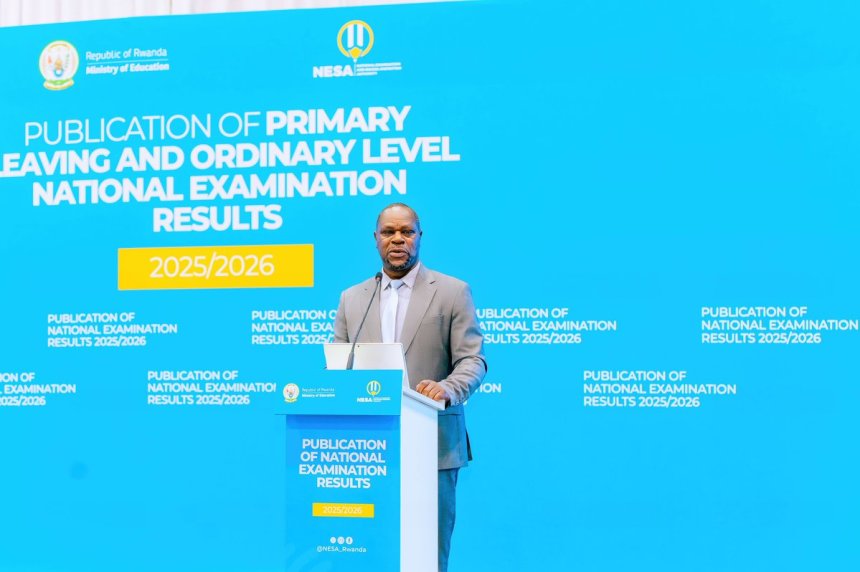
Across Rwanda, 277,593 pupils registered to sit the Primary Six national examinations, while 276,579 actually took the exams. Girls accounted for the majority of candidates at 55.65%, compared with 44.35% for boys.
NESA said 82.24% of the students who sat the Primary Six national examinations passed successfully. This represents a significant improvement from the 2024/2025 academic year, when the pass rate stood at 75.6%.
NESA also reported that 87.1% of girls passed the national examinations, compared with 89.56% of boys.
Among the subjects examined at this level, students recorded higher pass rates in Mathematics and Science compared with the 2024/2025 academic year. However, performance in Kinyarwanda and English declined.
NESA also presented the performance ranking of districts. The ranking was based on two main categories. The first assessed pupils’ performance during the final three years of primary school, while the second focused on the national examinations themselves.
Based on pupils’ performance over the past three years, from Primary Four to Primary Six, Gasabo, Kicukiro, Nyarugenge, Kayonza, Muhanga, Gakenke and Burera were the topperforming districts. In the national examinations themselves, NESA said there was no difference in the leading districts compared with the 2024/2025 academic year.
At the lower secondary level, 149,550 students registered for the national examinations, while 149,015 actually sat them.
Girls again constituted the majority of candidates, accounting for 57.22%, while boys represented 42.7%.
Of the students who sat the examinations, 85.70% passed successfully. This was a major improvement compared with the 2024/2025 academic year, when the pass rate for the lower secondary national examinations was 64%.
Among girls who sat the examinations, 82.63%passed, while 89.8%of boys passed.
Compared with 2024/2025, performance improved in Mathematics, Biology, Chemistry, Physics, Geography, History, Kinyarwanda and English. Entrepreneurship was the only subject in which performance recorded a slight decline compared with the previous academic year.
As with primary education, NESA ranked districts in two categories: students’ performance over their three years of lower secondary education and performance in the national examinations themselves.
For performance over the previous three years, Kayonza, Kirehe, Rusizi, Gicumbi, Nyanza, Ngororero and Nyagatarewere the leading districts.
In the national examinations themselves, Kirehe, Musanze and Karongi were the top performing districts, while Gakenke, Gasabo and Nyarugenge recorded the lowest performance.
Among the best performing Primary Six students, Rwego Mutijima Bruno Licky, a student at École Internationale la Racine in Bugesera District, emerged as the top performer with 99.6%.
Seven students shared second place, each scoring 99.4%. They were Ntwari Ngabo Pacifique of Wisdom Centre in Bugesera; Ineza Singizwa Musengimana Annie of École Internationale la Racine in Bugesera; Byoseniyo Aimé Albine of Kigali Harvest School in Gasabo; Irumva Bigwi Hugo of Apacope in Nyarugenge; Ingabire Ella Jessica and Shingiro Ivan Muhimba, both of École Saint André in Muhanga; and Cyusa Mugisha Ivan of École Les Rossignols in Kamonyi.
At the lower secondary level, two students jointly took first place, each scoring 98.7%. They were Uwamariya Léontine of ISF in Nyamasheke and Musonga Isimbi Ola of FAWE Girls School in Gasabo.
Other top performers included Ganza Joel of École Saint Ignace in Gasabo, who scored 98.6%; Uwitonze Kefa Milton of Collège Saint André in Nyarugenge, who scored 98.4%; and Kwizera Mukwiye Richard and Uwase Divine, both of Byimana Science School in Ruhango, who each scored 98.3%.
All the award winning students in the two categories received certificates recognising their outstanding performance, computers and school supplies. Umwalimu SACCO Cooperative also covered their school fees for the entire academic year.
Closing the event, the State Minister in the Ministry of Education, Irere Claudette, urged parents to enrol children in school when they reach school age, saying that starting school early contributes to better academic performance.
"When a child studies well on time, it makes what we have seen here possible. You have seen that all those who were first are young. They have studied well; they have been well followed. So, if this is not done, and they start late, it results in them not studying well," she said.
She also urged parents to first verify that the schools where they intend to enrol their children meet all NESA requirements by consulting ireme.nesa.gov.rw. She called on schools that have not yet fulfilled the requirements to work closely with NESA during the remaining two weeks before the start of the 2026/2027 academic year so that they can be inspected and assessed for approval to admit students.
Minister Irere also urged school administrators to prioritise cleanliness across school facilities, including classrooms, dining areas and dormitories.
She particularly called on all relevant stakeholders to ensure that schools have reliable disaster preparedness measures, noting that Rwanda could experience heavy rains in September, according to the Ministry in charge of emergency management.
Minister Irere further reminded schools that alcohol and drugs must have no place in schools.
She clarified, "No school should be free from alcohol and drugs. Whether it's a teacher, the principal, school staff or students themselves, if they are caught using drugs, they will definitely be punished, they will be expelled. This will not be tolerated!"
She linked the issue to discipline in schools, warning against all forms of violence involving students and teachers.
She said, "Acts of violence, whether committed between students, against teachers, or against students, will not be tolerated! Where it is indeed seen, those who are found guilty will be punished!"
Minister Irere also clarified some of the recently announced education reforms.
She stressed that the school day starts at 8:00 a.m. and ends at 5:00 p.m. She explained that formal lessons conducted with the teachers, end at 3:30 p.m., while the period from 3:30 p.m. to 5:00 p.m. is reserved for activities designed to help students better understand what they have been taught. It is therefore not a period for students to leave school.
She also addressed the contribution paid by parents, saying that the new contribution will begin in January 2027, with specific guidelines to be issued regarding its payment.
For students enrolled in teacher training colleges, she said they will study for three years this academic year and then sit an examination at the A1 university level.