UN Trains ILPD Law Students on Human Rights and Justice.
The United Nations has trained students at Rwanda’s Institute of Legal Practice and Development (ILPD) on human rights and the role of legal professionals in ensuring justice is administered in accordance with national and international law.

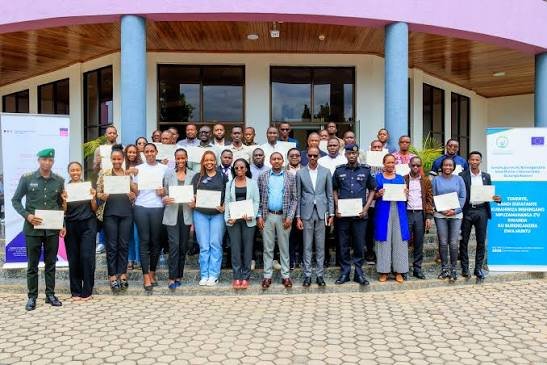
The training was delivered through a public lecture by Michael Ngabirano, a senior human rights adviser at the United Nations Office of the High Commissioner for Human Rights (OHCHR).
Ngabirano introduced the students to international human rights law, including relevant United Nations treaties and African Union instruments on human and peoples’ rights.
“All legal professions share the responsibility of understanding and implementing domestic laws as well as international human rights instruments,” he said.
He explained that human rights cannot be effectively protected at the national level without independent justice institutions, including courts, prosecution services and the legal profession, that are knowledgeable about human rights.
Ngabirano said courts have a primary responsibility to interpret and apply the law, adding that judges must understand the fundamental rights guaranteed under international law to make well-reasoned decisions and deliver fair justice.
He cited the International Covenant on Civil and Political Rights (ICCPR), which guarantees everyone the right to liberty and security of person.
“No one should be arbitrarily arrested or deprived of their liberty in disregard of the law,” he said.
Ngabirano noted that arbitrary arrests and detention remain a major global concern despite protections provided under Article 9(1) of the ICCPR, Article 6 of the African Charter on Human and Peoples’ Rights, and Article 24 of Rwanda’s Constitution, which safeguard the right to liberty and prohibit unlawful arrest and detention.
He emphasised that imprisonment should be used as a last resort, after other available measures have been considered.
Under the ICCPR, anyone who is arrested must be promptly informed of the reasons for their arrest and the charges against them, he said.
Ngabirano also urged lawyers to remind their clients of their right not to incriminate themselves and to be treated with dignity from the moment of arrest. He encouraged them to seek timely judicial intervention whenever investigators or prosecutors violate the rights of suspects.
He called on prosecutors to bring charges only when they have sufficient evidence obtained lawfully. They should also respect legally prescribed limits on pretrial detention and promptly share any exculpatory evidence with defence lawyers.
Courts, he added, have a duty to review whether every detention complies with the law, issue reasoned decisions and avoid relying on evidence obtained in violation of a suspect’s rights.
Twahirwa Uwanjye Benitha, an ILPD student, told reporters that the training had helped students understand international human rights standards and how they could apply them in their future legal careers.
“We were taught that the rights of a person accused of a crime must not be violated before they are convicted. Even if someone is found guilty, their rights must still be respected, including while they are in prison,” she said.
ILPD Deputy Director in charge of academics, Dr Yves Sezirahiga, said the institution’s students include newcomers, those continuing their studies and those nearing graduation. He said all needed to understand what the law provides for individuals and how their rights must be respected.
“Whether they become judges, prosecutors or lawyers, they must understand the law and human rights. That is why we took the time to explain and teach them about human rights so that they can put these principles into practice,” Sezirahiga said.
ILPD admits students from Rwanda and other African countries. Its international students include nationals of The Gambia, Cameroon, South Sudan, Nigeria, Uganda, Burundi and the Democratic Republic of Congo.