How YEFFA Turned a Teacher into a Job Creator
GATSIBO, RWANDA — Three years ago, Fadhella Modeste was earning RWF 150,000 a month as a primary school teacher. Today, the 26-year-old runs a growing poultry enterprise generating about RWF 3.6 million in monthly revenue, employs workers and has created opportunities for young people and women in his community.


His journey reflects a broader ambition of the Youth Entrepreneurship for the Future of Food and Agriculture (YEFFA) programme: to help young people see Africa’s food systems not only as a source of employment, but also as a platform for entrepreneurship, enterprise growth and job creation.
Supported by the Mastercard Foundation and implemented by AGRA in partnership with organisations across Africa, YEFFA seeks to connect young people with skills, finance, markets and opportunities across food and agriculture value chains.
In Rwanda, Akazi Kanoze Access is one of the partners implementing YEFFA, with a focus on the Eastern Province. Between 2024 and 2027, the organisation aims to support 10,000 young people to build sustainable livelihoods and become self-employed agripreneurs — or “own bosses.”
Modeste is one of the young people whose career trajectory has been reshaped by that approach.
From teacher to entrepreneur
Agriculture was not part of Modeste’s original career plan.
After completing his studies, he became a primary school teacher, earning approximately RWF 150,000 — about US$100 — a month.
That changed after he participated in entrepreneurship and work-readiness training through YEFFA, delivered by Akazi Kanoze Access.
The training encouraged young people to examine their communities, identify unmet needs and consider how those gaps could become business opportunities.
For Modeste, the exercise led him to agriculture.
“They trained us on how to quit working for other people and become our own bosses. I saw that there was a gap in agriculture, and I started producing to fill that gap in my district,” he says.
Rather than waiting for another formal job, he decided to create one for himself.
From 50 chicks to 1,000 layers
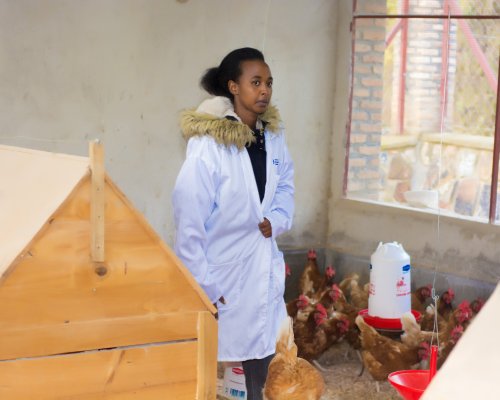
In 2024, Modeste entered poultry farming with RWF 230,000 and 50 chicks.
He started small, sold the birds, reinvested his profits and gradually expanded.
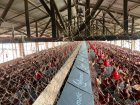
Fifty chickens became 100, and the business continued growing until he reached 1,000 layer chickens at his farm in Gatsibo District.
The enterprise now produces approximately 800 eggs a day and generates reported monthly revenue of around RWF 3.6 million, equivalent to about US$2,435.
For Modeste, however, the significance of the business goes beyond revenue.
His enterprise is increasingly becoming a source of employment and opportunity for people around him.
From one job to several
Modeste currently employs three permanent workers at the farm.
He has also mobilised three young bicycle transporters who help move eggs and other agricultural products for his business and other producers in the area.

His ambitions have also extended beyond poultry production.
Seeing the need for local trading space, he invested approximately RWF 3 million to construct a market, creating space for 27 young women and girls to sell locally produced agricultural products.
The result is a small but growing local food-system enterprise connecting production, transportation, employment and markets.
What began with 50 chicks has therefore become more than a poultry farm. It has created opportunities for others to participate in the local economy.
The role of YEFFA
Modeste says YEFFA played an important role in helping him see agriculture differently.
“I appreciate YEFFA because if I had not met YEFFA, I was not thinking of joining the agriculture sector. After the training, I saw that there was a gap in agriculture.”
That experience reflects the broader objective of YEFFA: to equip young people with the skills, confidence and connections needed to participate in food systems as entrepreneurs and job creators.
The programme combines entrepreneurship and work-readiness support with access to finance, savings, agribusiness mentorship and market linkages through its various implementing partners.
In Rwanda, Akazi Kanoze Access is one of the organisations working with YEFFA to deliver this support to young people in the Eastern Province.
According to Ernest Nzabarinda, Project Manager at Akazi Kanoze Access, the programme seeks to change how young people view work and entrepreneurship.
“We equip youth with employability and work readiness skills while encouraging them to become self-employed and their own bosses,” he says.
Between 2024 and 2027, Akazi Kanoze Access is targeting 10,000 young people in Rwanda’s Eastern Province under its YEFFA intervention.
The focus is not simply on encouraging young people to become farmers. The programme seeks to help them identify opportunities across the wider food system — from production and processing to agricultural inputs, transport, marketing and other services.
Agriculture as a business opportunity
For Modeste, YEFFA’s greatest contribution was not simply teaching him how to run a business.
It changed his perception of where his future could lie.
“I appreciate YEFFA because if I had not met YEFFA, I was not thinking of joining the agriculture sector. After the training, I saw that there was a gap in agriculture.”
That realisation gave him the confidence to start with what he could afford rather than waiting until he had enough money to build a large enterprise.
He now describes YEFFA as a trigger for his transformation.
“If I could continue working for RWF 150,000 per month, I could not be a CEO today. But as you can see me, I am becoming a CEO, and I have started employing other youth.”
His experience also illustrates an important part of building sustainable youth enterprises: skills can help young people identify opportunities, but business growth also depends on access to capital, markets and business networks.
Modeste is now engaging financial institutions and participating in business competitions as he seeks additional capital to expand his operation.
Looking beyond 1,000 chickens
The 1,000-layer farm is not the end of Modeste’s ambition.
He wants to increase production, expand his business and create more opportunities for young people and women.
His journey — from a teacher earning RWF 150,000 a month to an entrepreneur running a poultry enterprise generating millions of francs in monthly revenue — offers a glimpse of what can happen when skills development is connected to real economic opportunities.
For YEFFA, stories such as Modeste’s are part of a broader effort to position young people at the centre of Africa’s food-system transformation.
For Modeste, the transformation is personal.
He entered the programme looking for a different way to build his future.
He emerged seeing himself not only as someone who could find work, but as someone who could create it.
And his business is beginning to do exactly that.